
This is Part 2 of AI in Marketing: A Field Guide to Where It Helps and Where It Hinders.
AI certainly has value in marketing, and you absolutely should take advantage of that. Now that we know why AI behaves the way it does, it makes it much easier to spot exactly where it helps and where it needs a human counterpart.
Here’s how that plays out across common marketing tasks:
Brainstorming Organic and Paid Marketing Strategies: AI Works! ✅
AI can brainstorm ideas for marketing tools you might not have thought of or be taking advantage of yet. It’s good at aggregating data, so it can pull ideas from several sources to give you a more comprehensive list of tools to include your overarching marketing strategy.
Here are some specific categories of marketing that it would be helpful to use AI for research:
- Keyword research: generating seed keywords, related search terms, question-based keywords, and topic clusters
- Content ideas: blog topics, social media themes, video concepts, newsletters, and more
- Competitor categories: identifying types of competitors or marketing approaches worth researching
- Ad campaign ideas: generating potential angles, hooks, offers, or messaging themes to test
- A/B test ideas: brainstorming what elements could be tested, such as headlines, CTAs, offers, landing page layouts, or audiences
- Audience pain points: determining questions, frustrations, objections, and motivations your audience may have
- Content repurposing ideas: identifying ways to turn one piece of content into multiple formats
- SEO topic clusters: generating broader pillar topics and supporting content ideas
GEO (Generative Engine Optimization) Strategy: AI Works! ✅
AI SEO or GEO is the practice of getting your business recommended within AI-generated answers. This is one case where AI’s own nature works in your favor rather than against you.
Since AI is drawing on patterns, associations, and semantic relationships to generate its answers (the same tendency that makes it occasionally blur fine distinctions elsewhere), it’s well-suited to helping you understand what kind of content, structure, and language patterns tend to get surfaced in those AI-generated answers. You’re using AI to reverse-engineer AI.
That said, GEO doesn’t replace SEO. It’s still worth pairing your GEO strategy with a human marketer who can make sure it works in tandem with how actual people search and browse, not just how AI models respond.
Regular Updates to your Marketing Strategy: AI Needs Help ❌
Like we discussed, AI will almost always suggest changes when you’re checking in on your marketing strategy, regardless of the time it’s run or the full picture. So what if your strategy is actually on the right track?
Data can be just as valuable as leads. For instance, if you’ve only let your ads run for one month before determining they’re not working and abandoning the whole campaign, you could be interrupting the process of discovering exactly which changes will lead to success.
A human marketer better understands the nuances of gathering data and learning from it. The learning process is the value, because long-term success depends on it.
Writing Content: A Mix of Bot and Human 🟡
AI can make writing content much faster and more efficient. Similar to brainstorming content strategies, AI can help outline search-optimized topics to give you an idea of what people are asking within your given topic.
At the same time, human marketers ultimately know the product or service they’re writing about best. They infuse creativity, connection, and understanding into blogs and service pages that AI just cannot approximate. You’re selling to other humans, not bots, at the end of the day.
If you’ve ever read a blog or LinkedIn post and thought, “ChatGPT wrote every word of this,” you can understand how critical it is to have a human content writer and editor who is appealing to other humans.
Building a Website: A Mix of Bot and Human 🟡
Building a Claude website can save you a lot of time and money. That’s worth something. But consider the drawbacks:
Will Claude preserve your well-built SEO? Can your Claude website be easily revised and updated to evolve with your business? Is it built to convert or to look pretty?
We’ve sadly witnessed companies who have generated Claude-built websites only to discover they’ve decimated their SEO rankings in the migration process. Claude websites are also notoriously difficult to make changes to on the backend, and refinement becomes painful or impossible. We also discussed earlier how Claude and other AI tend toward patterns rather than differentiation, which is another downside when you’re trying to sell why you’re not exactly like your competitors.
AI is great for website inspiration, but it often requires other tools to achieve a reliable and well-designed final product. A good middle ground is to use an experienced web developer as your website’s head contractor and construction crew and Claude more as your blueprint draftsman.
Determining If a Marketing Strategy Will Work: AI Needs Help ❌
AI can analyze patterns in data, but it can’t independently generate real-world experience about your specific business. Your vertical, product offerings, price point, geographical location, website experience, published content, Google review quality, and close rate are all variables that AI has difficulty synthesizing into actionable strategy because it has no direct experience with it.
Here’s an example of why AI needs help:
I gave the same prompt to three of the most popular AI bots to see if each could give me a very specific, practical strategy for my fictional business.
My Prompt:
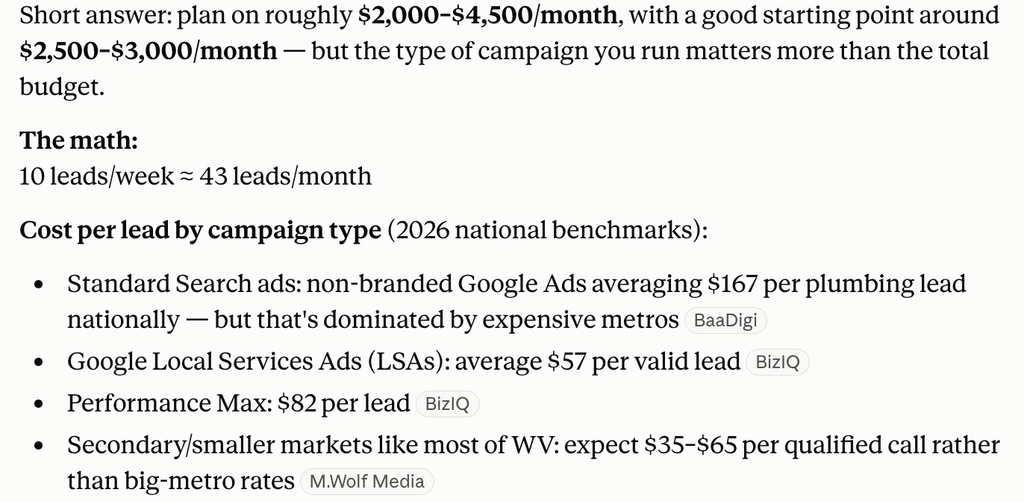
I am a plumber in West Virginia. How much money should I spend on Google Ads per month if I want 10 leads per week?
Claude’s Output:
ChatGPT’s Output:

Gemini’s Output:
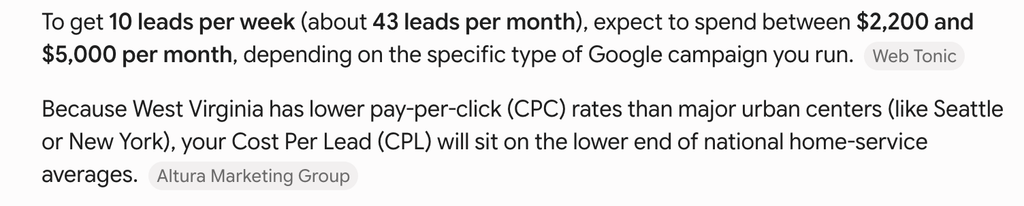
Results
As you can see from the outputs, I’ve been advised to spend anywhere between $2000 and $6000 a month without being asked any further details about my business. If I listened to the bots, I could be wasting up to $4000 a month on unnecessary spend.
And remember, AI is efficient, not inquisitive. So while each AI model did tell me to consider CPC, CPL, and campaign type, they all came to notably different conclusions without asking questions like:
- In which West Virginia city is my business located?
- Do I have employees or am I a one-man-band (can I realistically handle this lead volume)?
- What’s my close rate?
- What does my website look like? Is it easy to navigate?
- Can people book on my site?
Basically, these AI models gave answers (that varied widely, because AI is nondeterministic) based on the patterns they pulled from rather than predicting the exact right strategy for my business.
To be fair, a human can’t necessarily predict the exact right strategy either. But human marketers see success and failure first hand. They record what works for certain industries, demographics, and online experiences, and they A/B test new strategies to stay current. They have the ability, unlike AI, to infer what will work for your business based on judgement that has been repeatedly shaped by how these strategies behave across real businesses. Human marketers work with patterns, yes, but they break the rules: they can use reasoning to determine how to distinguish your business from competitors.
Social Media Marketing: A Mix of Bot and Human 🟡
AI is a great brainstorming partner for social media. It can generate caption ideas, suggest a posting cadence, and pull inspiration from what’s trending in your industry faster than a human scrolling for research ever could.
Where it falls short is judgment. Social media lives and dies by timing, tone, and cultural context: knowing when a trending format fits your brand and when it would feel tone-deaf, recognizing when current events make a scheduled post suddenly inappropriate, or reading a comment section and knowing exactly how your brand should (or shouldn’t) respond.
AI doesn’t know your brand voice was built over years of real customer interactions, and it doesn’t know what happened in the news this morning unless you tell it. A human still needs to be the one ultimately hitting “publish.”
Retargeting & Paid Social Ads: AI Needs Help ❌
Like ad spend for new leads, retargeting strategy depends on data AI doesn’t have access to, such as your average sales cycle, where in the funnel people are bouncing, and customer experience on your landing page.
Ask AI to build you a retargeting strategy and it will give you a technically sound, industry-standard framework, but it has no way of knowing if your leads go cold after three days or three months, or whether your audience has already seen (and ignored) five ads with the same offer.
This is a live, ongoing job, not a one-time setup. A human marketer watching real performance data can adjust frequency, refresh creative before fatigue sets in, and shift budget the moment something stops converting. These decisions require continuously observing your specific results, which is exactly the kind of ongoing, business-specific learning AI can’t do on its own.
The Best Marketing Strategy Uses Both
AI isn’t going anywhere, and honestly, it shouldn’t. It’s a powerful tool for making marketing more efficient, uncovering ideas, and helping teams work smarter. The goal isn’t to avoid AI or question every suggestion it makes. It’s to understand what it’s good at, where its limitations show up, and when a human needs to step in. Use it to brainstorm your next campaign, organize your research, or find new angles to test. Just don’t confuse a well-written answer with a well-informed decision.
At the end of the day, good marketing isn’t about following a formula. It’s about understanding your business, your customers, and the things that make you different. AI can help you identify patterns and explore possibilities, but turning those insights into a strategy that actually works takes experience, judgment, and a willingness to learn from real-world results. Let AI help you work smarter, but let human expertise guide the decisions that move your business forward.
Looking for Human Assistance?
Reach out to one of our experts at Lemonade Stand to get a human-led, AI-assisted marketing strategy tailored for your business. Our team will guide help you take advantage of the best AI tools available while keeping a watchful eye on nuances AI can’t detect.